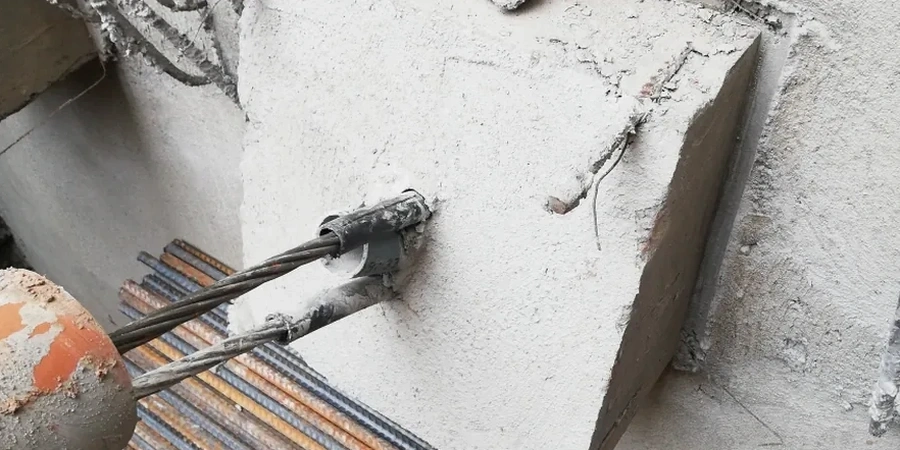
The Whanganui River basin doesn't just shape the landscape; it defines the ground conditions we work with every day. Soft alluvial silts, loose pumice sands, and layered gravels from centuries of flooding create a subsurface profile that demands more than a textbook anchor design. When a retaining wall on Taupo Quay needs to hold back 6 metres of saturated overburden, or a hillside cut on Durie Hill shows tension cracks after heavy rain, the difference between a passive anchor and a prestressed active anchor isn't academic. It's the difference between a structure that moves and one that stays put. We design ground anchors that work with Whanganui's ground, not against it, using site-specific pull-out tests and NZGS guideline load transfer models. For deeper site characterisation before anchor installation, we pair the design with CPT testing to map the stratigraphy in continuous profile without sample disturbance.
In Whanganui's pumice sands, a passive anchor doesn't just resist load; it teaches you about grain crushing at the grout-soil interface.
Process and scope
Here's what we've learned working in the lower North Island: pumice sands aren't just granular, they're crushable. Load a passive anchor tendon in a borehole filled with Whanganui pumice, and the grain crushing at the grout-soil interface changes the load-displacement curve in ways a generic Bond-type model won't capture. We see it on the load test graphs, a flattening before the peak, subtle but real. Our design approach separates active anchors, which we prestress to lock in a known force and limit movement, from passive anchors, which only engage when the structure deforms. The choice depends on the allowable displacement. A basement excavation next to a heritage building on Ridgway Street gets active anchors, every time. We follow NZS 3404 for steel tendon capacity and use local experience to adjust bond length estimates. The typical bond zone here runs 4 to 9 metres in the dense gravels, longer in the silts. We verify every anchor with a proof load test at 1.33 times the design load, minimum.
Local geotechnical context
Whanganui sits at 39.9 degrees south, on the edge of the Australian Plate, and the city has felt the long reach of earthquakes from the Hikurangi subduction zone, including the 1855 Wairarapa quake. A 2019 GNS Science report highlighted the Whanganui Basin's amplification potential, soft soils shaking like jelly in a bowl. An anchor designed only for static earth pressure becomes a liability when seismic loads cycle through. We design for the NZS 4203 seismic action combination, checking that the tendon stays elastic under the ultimate limit state load. Permanent anchors in the marine terrace deposits get double corrosion protection, because the groundwater here can be aggressive. The biggest risk we see isn't anchor failure; it's inadequate investigation. If you don't know where the gravel lens pinches out, you don't know where your bond zone really is.
Quick answers
How much does anchor design and testing cost for a typical retaining wall in Whanganui?
For a standard retaining wall requiring active anchor design, pull-out testing, and on-site supervision, the cost typically ranges from NZ$1,650 to NZ$5,430 depending on the number of anchors, access conditions, and whether permanent corrosion protection is needed. We provide a fixed-price quote after reviewing the site geology.
What is the difference between an active and a passive anchor?
An active anchor is prestressed after installation, applying a known force to the structure and locking it in place, which minimises movement. A passive anchor has no initial load; it only develops resistance when the ground or structure deforms enough to stretch the tendon. Active anchors suit structures sensitive to displacement; passive anchors work well for slope stabilisation where some movement is acceptable.
How do you determine the bond length in Whanganui's soils?
We start with NZGS guideline values based on the soil type, silt, sand, or gravel, then adjust using site-specific pull-out tests on sacrificial anchors. In Whanganui's pumice sands and river gravels, the bond length typically ranges from 4 to 9 metres, but we verify this for every project because the stratigraphy changes quickly across the basin.
Do you handle the anchor installation or just the design?
We provide the full design package, including tendon specifications, bond length calculations, and corrosion protection details, and we supervise the installation and proof testing on site. The drilling and grouting itself is performed by specialist anchor contractors; we ensure the work meets the design intent and the NZS 3404 requirements.