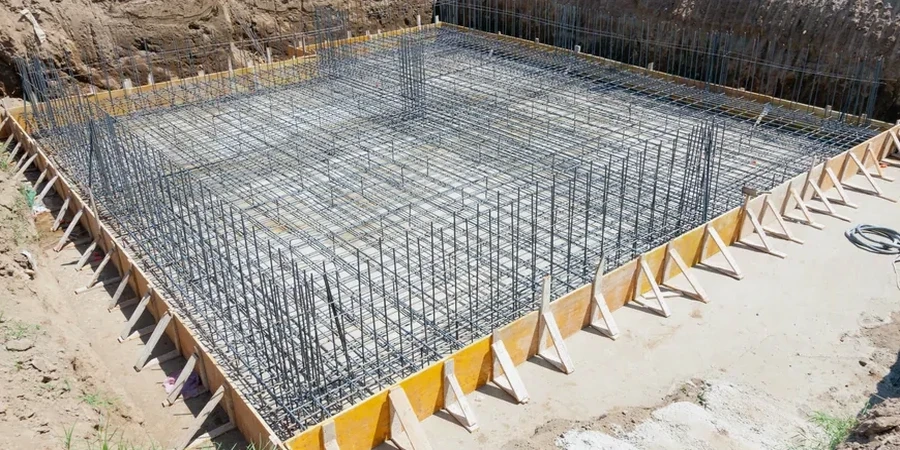
Whanganui’s expansion from a river trading post into a regional centre left a legacy of construction on the alluvial flats of the Whanganui River catchment. Many older commercial buildings near the riverbank and newer subdivisions on the city’s western terraces sit over compressible silts and loose sands deposited by centuries of flooding. In our experience, isolated footings rarely perform well on these profiles. Differential settlement shows up within a few years. A raft/mat foundation design changes the load distribution equation entirely. The slab spreads structural weight across a much larger footprint. This reduces bearing pressure on the soft upper layers. For sites where the groundwater table sits within 1.5 metres of the surface – common in spring around the Gonville and Castlecliff areas – the raft also acts as a barrier against moisture migration into the structure. We often pair the raft design with a prior CPT test to map the depth to competent bearing strata without the disturbance that boreholes cause in saturated silts.
A properly designed raft foundation on Whanganui’s alluvial soils does more than support the building – it bridges the unknown soft spots that isolated footings cannot see.
Local geotechnical context
NZS 3604:2011 sets the baseline for residential slabs, but its simplified ground conditions rarely capture Whanganui’s subsurface reality. The biggest risk we encounter is assuming a ‘good ground’ classification on a site that looks flat and dry in summer. Excavate a metre and you often hit grey, saturated silt that loses strength when remoulded. A raft foundation designed for the wrong soil class will tilt. That leads to inoperable doors, cracked cladding, and expensive releveling. Liquefaction-induced differential settlement is another hazard east of State Highway 3. The raft can be designed to survive it, but only if the seismic demand is correctly estimated. We model the post-liquefaction bearing loss explicitly. Ignoring this step is the single most costly shortcut a developer can take on the city’s floodplain margins.
Quick answers
What does a raft/mat foundation design cost in Whanganui?
For residential and light commercial projects, the design component usually ranges from NZ$1,640 to NZ$7,360 depending on slab area, number of ribs, and whether a liquefaction analysis is required by the council. This covers the structural calculations, drafting, and the PS1 producer statement.
Is a raft foundation better than piles in Whanganui?
It depends on the soil profile. Where liquefaction is the main concern and competent gravel is within 10 metres, piles may be cheaper. On thick, compressible silts where differential settlement drives the design, a raft slab is often the more controllable solution because it tolerates small movements better than a suspended floor on piles.
How long does the design process take?
Typically two to three weeks from receiving the final geotechnical report. This includes the analytical modelling, reinforcement detailing, coordination with the architect, and preparation of the building consent documentation.
What information do you need to start the raft design?
We need the architect’s floor plan with load-bearing wall locations, the finished floor level, and a geotechnical investigation report that includes bearing capacity, liquefaction assessment, and soil stiffness profiles. If the report is older than five years, we usually recommend a supplementary site visit.
Does a raft foundation need specific subgrade preparation?
Yes. The topsoil and any soft fill must be removed and replaced with compacted engineered fill. We specify a minimum compaction standard – usually 95% of the maximum dry density – and often require a proof roll or a few plate load tests before the slab is poured to confirm the subgrade meets the design stiffness.