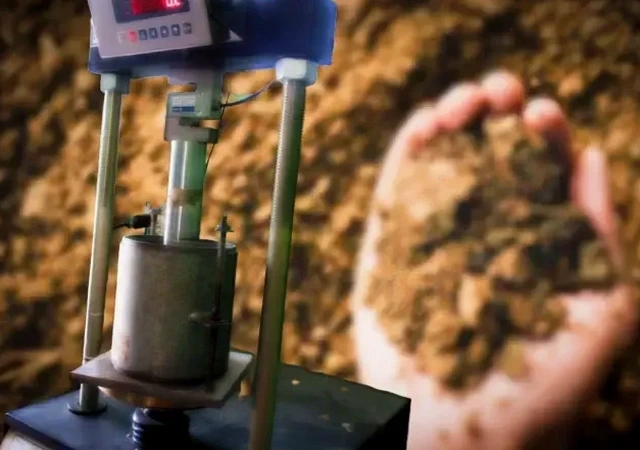
When a council in the Whanganui District requires a pavement design submission under NZS 4404:2010, the soaked California Bearing Ratio is the first number the reviewing engineer looks for. We run the laboratory CBR test in our own facility, which means we control the compaction, the four-day soak, and the surcharge weights exactly as the standard mandates. For subdivisions in Springvale or new driveways in Aramoho, the result is a defensible CBR value at 95% modified compaction that the roading designer can use directly. We often pair the test with a grain size analysis to check whether the material classifies as a granular fill under the NZTA M/4 specification, because a borderline silt content can drop the soaked strength more than the grading curve alone would suggest. Our team has processed hundreds of Whanganui samples, from the sandy loess common on the northern terraces to the alluvial silts of the river flats, so we know how the local geology influences the soak response before the piston even touches the sample.
A soaked CBR result of less than 3% on Whanganui's river silts typically triggers a subgrade replacement strategy that the pavement designer needs to cost before the earthworks tender is let.
Process and scope
Whanganui's geotechnical personality is shaped by the Whanganui River, which has laid down sequences of sands, silts, and peats that respond very differently to a four-day soak. The loess-derived soils on the higher terraces around St Johns Hill often read as a clean silt in a sieve analysis, but the CBR can collapse from 8% to below 3% after soaking if the material is moisture-sensitive — something the Atterberg limits can help flag before the full CBR programme starts. We compact the specimen in a standard CBR mould at the optimum moisture content determined by NZS 4402:2015 compaction testing, using a 4.5 kg rammer with the specified drop height. The surcharge rings are set to simulate the overburden pressure the subgrade will actually experience, which makes a measurable difference in the final bearing ratio. Our laboratory runs the penetration test at a constant strain rate of 1.27 mm per minute, recording the load at 2.5 mm and 5.0 mm penetration, and we always report both values so the designer can see whether the sample needed correction. Every mould is weighed before and after soaking to quantify the water uptake, because a sample that gains 5% moisture over four days tells a completely different story than one that remains stable.
Local geotechnical context
The performance gap between a Whanganui East site on the river terraces and a Castlecliff site on the coastal dune sands underscores why a single assumed CBR value for the whole city is a budget risk. River terrace soils — particularly the silty alluvium near Anzac Parade — can drop to a soaked CBR of 2.5% to 4.0%, which forces the pavement design into a thick aggregate or lime-stabilised layer that the developer may not have priced. Castlecliff sands, by contrast, often deliver soaked values above 10% when well-graded, but they are also more susceptible to cyclic softening under traffic because they lack cohesive fines. We have seen earthworks contractors in the district attempt to save on cartage by reusing site-won material that looked competent at the stockpile, only to have the laboratory CBR test return a soaked value half of what the design assumed — a discrepancy that changes the pavement cross-section and the contract sum. In our experience, testing three separate samples per material type provides a defensible statistical basis for the design CBR, which the council engineer can accept without further inquiry.
Quick answers
How much does a laboratory CBR test cost for a Whanganui subdivision?
For a single point CBR test run to NZS 4404:2010 — including compaction, four-day soak, penetration test, and a signed report — the typical range is NZ$180 to NZ$360 per specimen. The cost varies with the number of samples and whether we are also running a companion compaction curve and grading analysis on the same material. A full subgrade assessment with three CBR points, three compaction curves, and three gradings usually falls between NZ$1,200 and NZ$1,800 plus GST.
Can you run the CBR test on samples collected from our Whanganui site?
Yes — most of the CBR testing we do starts with bag samples delivered to the laboratory by the drilling crew or the earthworks contractor. We need roughly 25 kg of material per CBR point to run the compaction curve and the CBR mould. If the sample arrives moist, we air-dry it first, then rehydrate to the target moisture content during specimen preparation. For projects where the material is sensitive to drying, we can arrange to collect the sample directly from the test pit and transport it in sealed drums.
How long does the laboratory CBR test take from sample receipt to the report?
The standard turnaround is eight to ten working days. The four-day soak is the fixed part of the schedule — it cannot be shortened without invalidating the NZS 4404 reference. The remaining time covers specimen preparation, the compaction curve if it is being run in parallel, the penetration test, data reduction, and report drafting. We can expedite reporting to five working days when the compaction curve already exists and the earthworks programme is waiting on the CBR value to confirm pavement thickness.