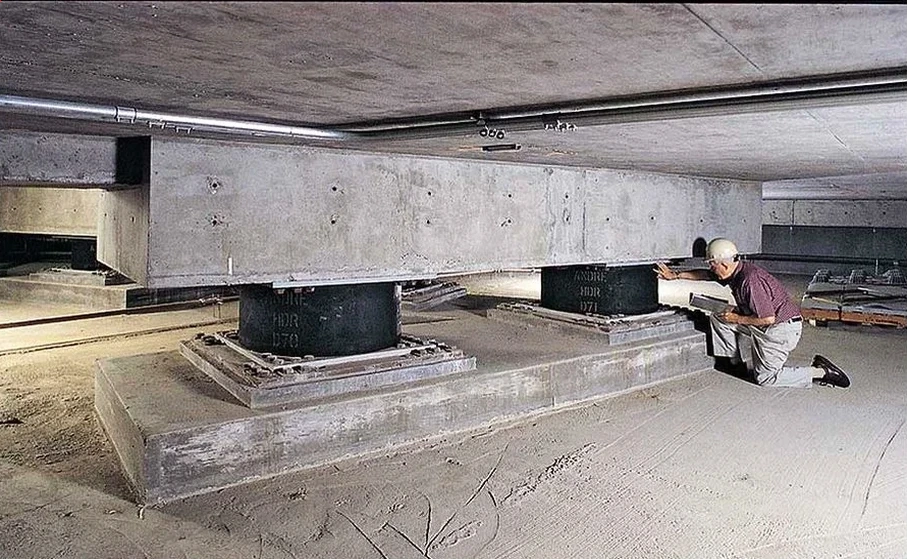
Whanganui sits on deep alluvial and marine sediments of the Whanganui Basin, a basin that can amplify earthquake shaking in ways standard fixed-base design can't fully address. The Magnitude 6.5 Wanganui earthquake of 1942 was a sharp reminder of what lies beneath, and since then our understanding of site-specific response has advanced dramatically. Base isolation seismic design changes the equation entirely. Instead of forcing a building to fight ground motion, we introduce horizontally flexible bearings that let the ground move independently underneath. For critical projects in Whanganui, this means the superstructure stays nearly still during a major event. Our approach integrates the latest NZGS guidelines with site-specific seismic hazard analysis to select the right system—elastomeric, lead-rubber, or sliding pendulum. It's an upfront investment that pays for itself in damage avoidance, especially on soft soil profiles where spectral accelerations can spike unexpectedly.
A well-tuned base isolation system in Whanganui's deep basin soils can reduce seismic forces by a factor of 3 to 5 compared to fixed-base design, preserving both structure and function.
Local geotechnical context
The Whanganui Basin contains over 4000 metres of Plio-Pleistocene sediment, creating a textbook basin-edge effect that traps and amplifies long-period energy. That's exactly the frequency range where isolated structures live. If site-specific hazard analysis isn't done properly, the isolator period can accidentally align with basin resonance—a phenomenon observed in multiple international events. The consequence isn't just higher displacement; it's potential pounding at the moat boundary, ruptured service lines, and isolator failure modes that bypass the isolation entirely. We always run a suite of ground motion records scaled to both the uniform hazard spectrum and conditional mean spectrum for Whanganui coordinates. Without this, you're designing blind to the most dangerous scenario your building will actually face.
Standards that apply
NZS 1170.5:2004 – Structural design actions – Earthquake actions, NZS 3404:1997 – Steel structures standard (isolator mounting plates), NZS 4203 – General structural design (historic reference, superseded by NZS 1170 but referenced in existing building upgrades), NZGS guidelines for site classification and seismic hazard analysis, AS/NZS 5100.2:2017 – Bridge design – Design loads (for sliding pendulum bearings in transport structures)
Quick answers
What does base isolation design typically cost for a Whanganui commercial building?
For a mid-rise commercial or institutional project in Whanganui, the base isolation design package (analysis, isolator specs, detailing, and peer review) typically ranges from NZ$7,540 to NZ$13,380, depending on structural complexity and number of ground motion records required. The isolator hardware itself is a separate procurement.
How does Whanganui's deep soil profile affect isolator performance?
The deep sediments of the Whanganui Basin tend to amplify long-period ground motion components. This can increase isolator displacement demands compared to rock sites, so our designs target an effective period long enough to avoid basin resonance while keeping displacements within practical bearing limits.
Is base isolation feasible for an existing building retrofit in Whanganui?
It is feasible but requires careful staging. The structure must be temporarily supported while columns are cut and isolators inserted—a process well-suited to buildings with accessible foundation levels. We assess the existing lateral system first to ensure load path continuity through the new isolation plane.