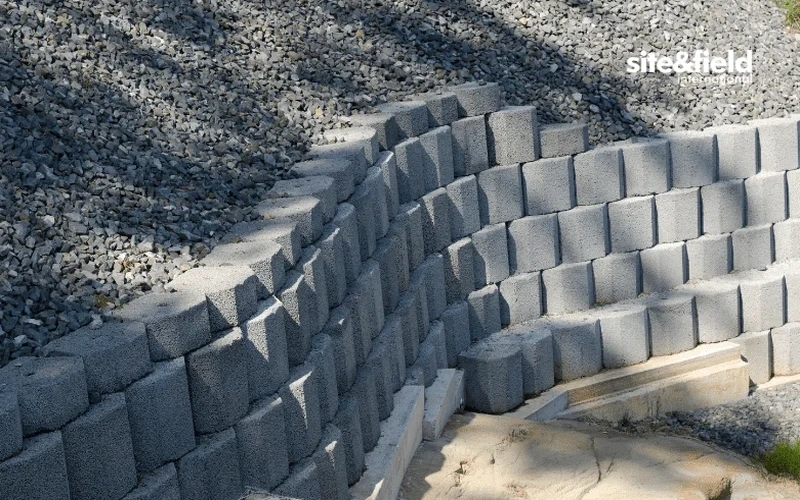
In Whanganui, we often see retaining walls specified without sufficient thought to the backfill material and groundwater behind them. With the city’s mix of volcanic pumice sands from the ring plain and dense alluvial silts near the river, the lateral earth pressures can vary wildly across a single site. A standard gravity wall that works on the flat terraces might fail on the steeper slopes of Durie Hill if you don't account for pore-water pressure buildup. Our approach starts with a proper CPT test to get continuous soil stratigraphy, and we use that data to calibrate our pressure diagrams rather than relying on generic textbook values. With Whanganui’s average annual rainfall sitting around 900 mm and occasional heavy weather systems, drainage design is just as critical as the structural section itself.
In Whanganui, the difference between a 50-year wall and a failed one is usually the drainage detail, not the concrete strength.
Local geotechnical context
The soil conditions between Gonville on the flat and St John's Hill on the slopes tell two completely different stories. Down on the Gonville terraces, you're typically dealing with a few meters of sandy topsoil over river gravels; the bearing is decent, and groundwater is deep enough that hydrostatic pressure behind a wall is manageable. But up on the St John's Hill side, you hit weathered mudstone and residual soils that hold water like a sponge. If you design a wall there using the same drainage assumptions as Gonville, you'll end up with a structure that's constantly saturated and under far higher pressure than calculated. The other risk we see across Whanganui is uncontrolled fill placement. Old sections of the city near the river have historical fill that includes brick rubble and organics, and that material will settle and impose negative skin friction on any soldier pile or anchor rod passing through it. We always run a few hand auger holes or test pits to confirm fill depth before finalizing the wall design.
Standards that apply
NZS 3404: Steel Structures Standard (for embedded retaining walls and anchors), NZS 4203: Code of practice for general structural design and design loadings for buildings, NZS 1170.5: Structural design actions – Earthquake actions – New Zealand, NZGS Guidelines for Retaining Wall Design (MBIE/NZGS Module 6), AS/NZS 4678: Earth-retaining structures, NZS 4229: Concrete masonry walls (for segmental block retaining walls)
Quick answers
When is a building consent required for a retaining wall in Whanganui?
Under the Whanganui District Council rules, any retaining wall higher than 1.5m measured from the lowest ground level to the top of the wall requires a building consent. Walls supporting a surcharge like a driveway or building foundation may need consent even if they are shorter. Our design package includes all the producer statement documentation (PS1 design) that Council requires for processing.
What lateral earth pressure coefficient do you use for Whanganui soils?
We determine the active earth pressure coefficient (Ka) from the drained friction angle measured in our triaxial or direct shear tests, typically using the Coulomb or Rankine method depending on wall friction and backslope angle. For at-rest conditions, like a propped basement wall, we use Jaky's formula (Ko = 1 - sin φ'). Passive resistance in front of the wall is calculated with a factor of safety of at least 2.0 on the passive wedge.
How much does a retaining wall design cost for a residential project?
For a typical residential retaining wall in Whanganui, you're looking at a design fee between NZ$1,700 and NZ$8,040. The cost depends on the wall height, complexity of the soil profile, and whether we need to run additional lab testing like triaxial compression on the backfill material. A simple 2m cantilever wall on a flat site will be at the lower end, while a 4m anchored wall with multiple tie-back levels and seismic analysis sits at the upper end.
Do you need to do site-specific soil testing for every retaining wall?
Yes, we won't design a retaining wall in Whanganui without site-specific geotechnical data. The variability in the near-surface soils here, from the pumice-rich sands of the ring plain to the silty alluvium along the Whanganui River, means that relying on generic bearing capacity assumptions is risky. At a minimum, we need a logged test pit or CPT sounding to the base of the expected failure wedge, plus lab classification of the retained soil.
What drainage is required behind a retaining wall in Whanganui?
We always specify a free-draining granular backfill column at least 300mm wide directly behind the wall, with a perforated collector drain at the base connected to a suitable outfall. The drainage aggregate must have less than 5% fines passing the 75-micron sieve, which we verify through a grain size analysis. On sites with high groundwater or clayey backfill, we may add a geocomposite drainage layer against the wall face and weep holes at 2m centres to relieve hydrostatic pressure.