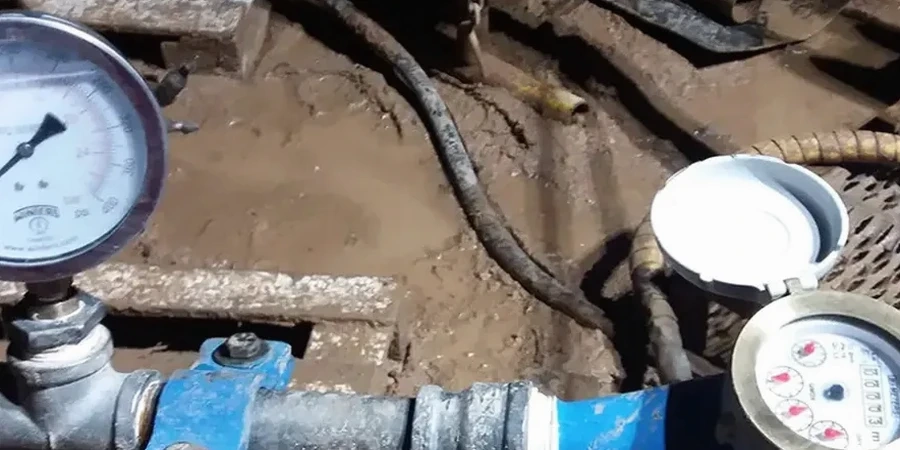
The Lefranc packer system we deploy around Whanganui is a straightforward piece of kit—a slotted pipe section isolated between inflatable rubber bladders, lowered into a borehole to test a discrete interval of soil or rock. What makes it tick is the constant-head control panel at surface, where we log flow rates under steady hydraulic gradients. With the city’s terrain stepping from coastal dune sand near Castlecliff into the silty alluvium of the floodplain and up onto the laharic breccias inland, a single permeability value across a site is meaningless. We run variable-head Lefranc tests in the softer silts and constant-head Lugeon tests in fractured ignimbrite, often pairing the test setup with a MASW survey to cross-check stratigraphic boundaries before selecting test intervals. That combination saves clients from misinterpreting a low-flow zone as an aquitard when it’s actually a weathered horizon with smeared borehole walls.
A disturbed-sample gradation might suggest 5x10⁻⁶ m/s; a properly surged Lefranc test in Whanganui’s compact silty ashes often returns 8x10⁻⁷ m/s—and that difference dictates whether the dewatering system works.
Process and scope
A mistake we see too often is contractors assuming permeability from a single gradation curve run on a disturbed sample. They’ll look at a sandy SILT label, guess 1x10⁻⁵ m/s, and size a dewatering system around that. Then the Whanganui summer rolls in, the water table barely drops, and the excavation stalls. Silt-sized particles in the city’s volcanogenic deposits are angular and pack tight, producing in-situ conductivities an order of magnitude lower than a textbook estimate. We’ve pulled Lefranc results showing 8x10⁻⁷ m/s in material that a particle-size analysis alone would peg at 5x10⁻⁶ m/s. That gap is the cost of a flooded footing. Our approach is to run the test at the depth of the proposed sump or cutoff, record pressure and flow until steady state, then run it again after surging the interval to break the smear layer. The NZGS guidelines on soil description give us the framework, but the local experience—knowing that the Waitotara-sourced ashes behave differently from the Kai Iwi sands—is what makes the number reliable.
Local geotechnical context
Whanganui’s urban footprint grew along the river terraces and the coastal plain, where the ground alternates between free-draining dune sand, tight volcanic silts, and buried peat lenses from former swampy hollows. When a new commercial building goes up on Taupo Quay or a subdivision extends into the Otamatea hills, the drainage assumptions shift metre by metre. The biggest risk we encounter is perched groundwater: a sand layer at 3 m saturated over an impermeable silt at 5 m, with the real regional aquifer 12 m down. A single borehole water level reading misses that entirely. Without a Lefranc test at the perched horizon, the structural engineer designs a tanked basement for an assumed hydrostatic pressure that may never materialise at depth but will push on the slab from above. Conversely, ignoring a permeable fracture zone in the ignimbrite beneath a stormwater infiltration trench can lead to concentrated recharge and slope instability in the St Johns Hill area. We treat every test as a puzzle piece that either confirms or challenges the conceptual site model, and we log it in enough detail that the designer doesn’t have to guess.
Quick answers
How much does a Lefranc or Lugeon test cost in Whanganui?
For a typical investigation with two to three test intervals per borehole, budget between NZ$920 and $1,960 per day depending on depth, access, and whether you need just Lefranc in soil or Lugeon in rock. That covers the packer system, pump, flowmeter, calibration, and our technician on site. If the borehole is already drilled and we only show up for the testing, the cost comes in at the lower end.
What depth can you test in Whanganui’s ground conditions?
In soil we typically test from 1.5 m down to about 25 m, provided the borehole stays open. In the ignimbrite we’ve run Lugeon tests past 40 m. The practical limit in Whanganui isn’t the equipment—it’s whether the hole collapses in the sandy layers before we get the packer seated. We often case through the overburden and advance open-hole in rock specifically to avoid that problem.
How long does a single permeability test take on site?
A variable-head Lefranc test in silt might run 20 to 40 minutes if the conductivity is low, because we need to see a stable recovery trend. A constant-head Lugeon stage in fractured rock can be quicker—10 to 15 minutes per pressure step, with five steps per test. Including setup, packer inflation, and surging, plan on roughly an hour per interval.
Do I need a Lefranc test if I already have particle-size distribution data?
Almost always yes for dewatering or drainage design in Whanganui. The gradation curve gives you a theoretical K from correlations like Hazen or Kozeny-Carman, but those formulas assume uniform, rounded particles. Whanganui’s volcanic silts are angular and compacted, so the measured in-situ value is frequently much lower. Relying solely on grain-size data is the single most common cause of undersized dewatering systems we see.