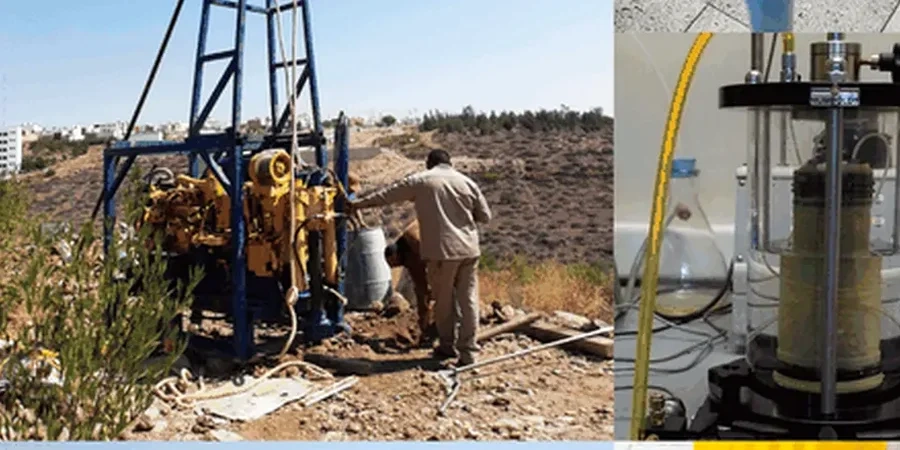
The Whanganui basin, with its deep deposits of alluvial silts and interspersed volcanic loess, throws up some real curveballs during site investigation. You can start drilling on a firm terrace near Putiki and, just a few metres down, hit loose sands or compressible organic layers left by centuries of river migration. That’s exactly why a standard approach doesn’t fly here. We run a complete soil mechanics study to quantify how the ground will actually behave under load, not just how it looks in a core sample. After extracting undisturbed samples, we focus on triaxial shear and consolidation metrics to nail down settlement potential before a structural design is locked in. For deeper profiling where SPT refusal might mask a tricky layer, we often recommend pairing the lab data with field results from a cone penetration test to get a smooth stratigraphic profile without gaps.
In Whanganui’s river terraces, undrained shear strength can vary by over 40% within a single metre vertically—lab testing catches what field logs miss.
Quick answers
What set of lab tests does a soil mechanics study in Whanganui typically include?
It depends on the ground profile and the proposed foundation. For a typical commercial building on the river terraces, we run Atterberg limits, particle size distribution, unconfined compression, direct shear, and one-dimensional consolidation. If the loading is significant or the silts are borderline soft, we add CIU or CD triaxial tests and possibly cyclic simple shear where liquefaction is a concern.
How much does a soil mechanics study cost for a residential project in Whanganui?
For a single-dwelling residential investigation with a targeted lab programme—classification, a few shear tests, and consolidation—you’d generally be looking at a range between NZ$4,830 and NZ$9,530. The spread depends on how many undisturbed samples we pull and how many stress paths the structural design needs confirmed.
Why is consolidation testing particularly important in the Whanganui area?
Because the Whanganui basin contains deep deposits of normally consolidated and slightly overconsolidated silts and clays. These soils can compress significantly under fill or foundation loads, and the rate of consolidation (cv) can be quite slow. Without oedometer data, you risk underestimating both the magnitude and duration of settlement, which leads to serviceability problems in buildings and pavements.
How do you handle sensitive volcanic ash soils in the lab?
We treat Whanganui’s rhyolitic loess and ash layers carefully—minimising disturbance during trimming and using staged loading in triaxial cells. We compare undisturbed and remoulded strengths to quantify sensitivity. If the sensitivity is high, the report flags it so the site works plan avoids over-excavation and vibration that could trigger a strength collapse.
Can you combine lab testing with in situ field data for a single report?
Yes, that’s the standard workflow. Our lab team works with the site investigation crew to pair triaxial and consolidation results with CPT tip resistance, SPT N-values, or shear wave velocity profiles. The combined interpretation gives a much more reliable ground model than lab or field data alone, especially in the variable alluvial sequence around Whanganui.